Total Page views

Showing posts with label Pan Macmillan. Show all posts

Saturday, October 23, 2021

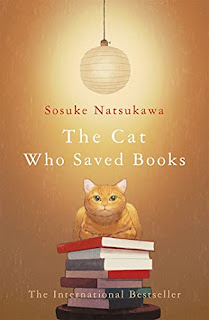
THE CAT WHO SAVED BOOKS


TITLE -  THE CAT WHO SAVED BOOKS 

WRITTEN BY - SOSUKE NATSUKAWA

TRANSLATED BY - LOUISE HEAL KAWAI 

PUBLISHED BY - PAN MCACMILLAN/PICADOR

PUBLICATION DATE - 16TH SEPTEMBER, 2021

Combining two of my favourite things, cats and books, “The Cat Who Saved Books” by Sosuke Natsukawa was a pleasant, quirky surprise. 
Following the death of his grandfather, the proprietor of a secondhand bookshop, Rintaro Natsuki prepares to close the shop for good and move away when a tabby cat called Tiger saunters into the store and whisks Rintaro away on a bizarre quest to rescue “imprisoned” books from a succession of labyrinths. Tiger is, of course, a talking cat and sassy with it.
The intrepid and unlikely duo meet many colourful characters along the way, including a man who reads thousands of books but never rereads any as there are too many to get through, another who cuts up books to enable speed reading, and one who wishes only to sell books as disposable products. All are deemed by Tiger to have imprisoned, harmed or treated books badly and so must be put to rights by this odd couple and their books freed. 
Author Sosuke Natsukawa, a Japanese doctor, has already enjoyed success with his previous book, the title of which translates as “God’s Medical Records”, which was made into a film in Japan. It wouldn’t surprise me if his latest book received the same treatment; it has the feel of a Studio Ghibli-type film. 
Translated skilfully and sympathetically by Louise Heal Kawai, the book is written in what appears to be a fairly simple way; this is not a bad thing because it makes the true depth of the story more profound. Rintaro is a lost soul at the beginning, often repeating “Grandpa, this is messed up” to himself as he tries to come to terms with his grandfather’s passing, but by the end of the story he gains strength and purpose. Tiger is a catalyst for Rintaro’s growth as a person. I cannot fault this book, other than to bemoan the fact that it isn’t longer! 
Overall, “The Cat Who Saved Books” is a quirky, fun and touching joy for those who love books…and cats!


Thursday, September 2, 2021

ALL THE NAMES GIVEN


Anyone worrying that Raymond Antrobus had mellowed after his debut book of poetry, “The Perseverance”, would do well to consider this extract from “Language Signs”, the third poem in his second collection “”All The Names Given”, 

“All the men who raised me are dead, those bastards. I’m one self-pitying prick of a son.”

Yes, these are angry poems, but they are often tinged with tenderness and hope. 

The book begins with poems exploring people through the ages who have shared the surname Antrobus, from slavers to painters, and their legacy, Achingly personal at all times, there are snapshots of Antrobus’ turbulent upbringing exploring themes of race, cultural identity and his own deafness, though the latter not to the same extent as in the previous book. It is always there in the subtext of his poems, though, as he relates awkward moments of miscommunication. The poems take us through Raymond’s life from difficult adolescence right up to his marriage. Many of the poems appear almost prose-like in structure, so much so that it has the feel of an autobiography at times and can be a tad overwhelming, but maybe that’s deliberate. The poetry of Raymond Antrobus is brutally direct and requires, even demands rereading. 

Having been blown away by “The Perseverance”, this new work doesn’t disappoint but it impresses in a different way. Antrobus experiments with poetic forms in order to tell his stories, something which is never less than thrilling. While I feel that this collection is maybe not quite as immediate as “The Perseverance”, it is still a raging, beautiful volume from one of the most important poets of his generation. Reading the poetry of Raymond Antrobus is a visceral experience that will leave you shaken.


BUY IT FROM BOOKSHOP.ORG!

Wednesday, July 14, 2021

MAYBE I DON'T BELONG HERE


Actor David Harewood pulls no punches in his autobiography in which he shares the formative events of his life that led to psychotic episodes after becoming an actor, and which ultimately led to him being sectioned twice. Harewood writes in such a friendly, conversational style that is so easy to read that it makes his harrowing depiction of the psychotic episodes that much more effecting. He is completely open about his breakdown and hopes that the book will encourage others, especially Black people, to overcome the stigma of mental health and seek help. 

He vividly describes his early childhood and an early life-changing experience of racist abuse in which his psyche is “split” into two separate personas, English and Black. This is juxtaposed with scenes of a warm and loving family life, his love of the TV comedians of the time and the rarity of seeing a black actor on television at the time. This is something I remember myself from growing up, and he paints a very familiar picture of late ‘60s, early ‘70s Britain. Soon David finds himself assimilating into the “white space”. His happy school life, in which he evolved to be the class clown, changes when his father is sectioned following a breakdown. Harewood sees similarities in the drastic changes both he and his father had to undergo through living in England and admits “the white space had taken its toll on both of us”. His parents later divorce also causes the young David a great deal of pain and confusion. 

We share his initial euphoria at becoming an actor which soon ends in a haze of alcohol and drug use due to psychological pressure from another actor. The title of the book is a phrase that Harewood keeps saying to himself as he struggles with his identity and feels rejected even by the “Black space” - “maybe I don’t belong here”.

It is around this time in his life when, David admits, his mind begins to unravel. He vividly describes his manic episodes where he would take walks late at night, wavering between periods of lucidity and psychosis, and often wake up the next morning in completely unfamiliar surroundings. The most extreme psychotic event results in him being arrested after believing the voice of Martin Luther King was in his head, directing him, and ends with David being sectioned twice and admitted to a psychiatric hospital. The chapter on this, entitled “The Ward”, is heartbreaking, and on the (probably unwise) advice of his brother he decides to “act normal” to get out of the hospital. Eventually, through sheer resilience, he is able to restart his acting career and to finally find inner peace while playing parts all over the world, which would ultimately lead to him starring in the show “Homeland”. He admits that his illness has given him a resilience to survive in the acting business and that it possibly shook “some of the bullshit” out of him. 

The book also touches on Harewood’s shock at discovering the disproportionate amount of black people in the mental health system in the UK. A 2019/2020 survey discovered that “Black and minority people suffer elevated rates of psychosis and schizophrenia compared with white people”. This leads to Harewood making his acclaimed BBC documentary, “Psychosis and Me”, in which he finally learns the real truth about how ill he had been during his breakdown and the production is a profoundly moving experience for him. 

This is a raw and honest book about being Black, (Harewood capitalises the word throughout) and about what it means to be Black with mental health problems. The book is refreshingly free of “luvviness”; Harewood necessarily mentions the famous actors he has worked with, but he never loses his starstruck amazement at meeting people like Al Pacino. He bemoans the greater opportunities for Black actors in the USA compared to the UK; pointing this out once got him into a bit of trouble. David Harewood’s book is heartbreaking yet hopeful, and I read it in one sitting. 


BUY IT FROM BOOKSHOP.ORG!