Total Page views

Showing posts with label poetry. Show all posts

Tuesday, May 10, 2022

IF I DIDN'T LOVE THE RIVER


TITLE - IF I DIDN'T LOVE THE RIVER 

WRITTEN BY - ROBERT PRIEST 

GENRE - POETRY 

PUBLISHED BY - ECW PRESS 

PUBLICATION DATE - 20TH SEPTEMBER 2022 


One of the poems in Robert Priest’s superb poetry collection “If I Didn’t Love The River” is entitled “What Francesca Does To English”, and upon reading it, you will be marvelling at the things Robert Priest does to English. This poetry will awe you. 

This book has many poems about love, but maybe no actual love poems in the strictest sense of that term. But there is much about the unpredictability and violence of love, and many a broken heart. 

Stars also play a role in several of the poems, affecting our lives in ways both benign and malevolent; but always randomly. There is humour too, as in “Why I See A Therapist” where Priest bemoans that everything reminds him of the Third Reich, but even this poem turns dark. 

Lighter moments are to be found though, such as the melodic and bouncy “Device”, a twisted tribute to the all-consuming power of the smartphone and its ilk. This is followed by a similar poem, “The Like Process”, an ode to that often elusive and addictive social media conformation. 

Several of the poems are visceral rants about nature and the planet and what mankind can and does do to it. Obviously the pandemic is one of the themes covered, resulting in the hilarious “Infection Prevention for Murderers” which cautions killers to practice social distancing. Sick, funny and brilliant. 

There are many sublime moments in this collection and I am grateful to have discovered Robert Priest’s work. I loved the words and the rollercoaster rhythm Priest imposes on them. Once you “get” his poetry, it gets you too and won’t let go. Mostly dark, even the humour comes at a price; Robert Priest makes you regret laughing as he skilfully twists the tone of the poems. Priest utilises many styles and poetical forms with a cornucopia of themes and images; the results are sometimes delicate, often brutal, but always stunning.


Friday, May 6, 2022

ELIOT AFTER THE WASTELAND

TITLE - ELIOT AFTER THE WASTELAND 


WRITTEN BY - ROBERT CRAWFORD


PUBLISHED BY - JONATHAN CAPE 


PUBLICATION DATE - 2ND JUNE 2022

“The Waste Land” by T. S. Eliot is one of my favourite poems, although anyone who has read it will know that the epithet “poem” barely does it justice. Eliot stands virtually alone in the pantheon of British poetry, creating verse that challenged the conformity and traditions of the time. 

I am a devotee of T. S. Eliot and I prepared for this book by reading Robert Crawford’s equally excellent first volume, 2015’s “Young Eliot: From St. Louis to The Waste Land”, in which he charted Eliot’s childhood and education, examining the eclectic (and often esoteric) influences on his burgeoning poetry that led to his epic poem. This second volume, entitled “Eliot After the Wasteland”, takes up Eliot’s life after the publication of that tumultuous, iconoclastic work; a period when he would write some of his most celebrated works, including “Four Quartets” and “Old Possum’s Book of Practical Cats” and several successful plays. 

As author Robert Crawford states in the introduction to this second volume of his biography, he proffers a deep dive into the life of T. S. Eliot; not only of the celebrated poet but also to the secret life of “Tom” as his friends and family knew him. Throughout, Crawford refers to Eliot as Tom. With unprecedented access to surviving letters and interviews with people who knew Eliot at the time (indeed, Crawford is the last biographer to interview anyone who knew Eliot when “The Waste Land” was first published). This is very much a book about T. S. Eliot the man. Crawford paints an unvarnished portrait of Eliot, brilliant but human. He does not ignore Eliot’s failings in favour of a hagiography; Tom’s bawdy racist poetry and almost casual anti-Semitism will no doubt shock the modern reader. 

It is easy to dive back into Crawford’s work and continue Eliot’s life story, who now feels almost like an old friend thanks to the detail with which the first book brought him to life. The distinguished gentleman gracing the cover is T. S. Eliot as we know him; a world away from the nervous-looking youth from the first volume. 

This volume picks up the Eliot’s story from the end of the previous volume with little preamble, so while there is no absolutely pressing need to read that book first, some readers may feel like they should. This is merely an observation, not a criticism: having read the first volume, I can put myself in the shoes of someone picking up this book fresh. And as the second volume of this work, it is to be expected. Crawford offers intelligent analysis of Eliot’s poetry throughout but confesses that this isn’t the main thrust of his biography. 

There are many developments in Tom’s life in this book - his continued yet hidden feelings for another woman, Emily Hale; the protracted breakdown of his marriage;  the subsequent death of his wife, Vivien; his life-changing involvement with the fledgling publishing company Faber & Gwyer (soon to become Faber & Faber, which publishes his first book of poems), his conversion to Anglo-Catholicism and full British citizenship. Indeed, religion is one of the main driving forces of Eliot’s life; so too is his surprisingly complicated love-life. But above all, the main constant and unwelcome companion of Eliot’s life was Vivien’s and his own ill-health. Sadly, in the latter part of his life this would continue, especially for Vivien. There are unflinching passages about her suffering, and also of Tom’s - one doesn’t know whether to laugh or cry at how often Tom gets struck down by influenza or some such ailment. He agonises over guilt that he may have in some way caused Vivien’s illness, even metaphorically “killing” her. 

Obviously, the Second World War looms large in this period of Eliot’s life, and we feel the national tension grow as conflict and even invasion becomes ever more likely. There is a lot of interesting detail about Eliot’s experiences as an ARP warden and it is fascinating to read how the war developed on an almost weekly basis through the prism of his life. By the end of the book, Eliot has become a major celebrity, warranting front page splashes in the Daily Mail when he married his much younger secretary, Valerie Fletcher, and finally finding happiness (and not a little eroticism). 

“Eliot After the Wasteland” is a remarkable achievement and I enjoyed it immensely, and will return to both it and its predecessor. However, there are a couple of factors that make this book an often difficult read. Firstly, Crawford frequently mentions that various organisations, collections of writing, even the recipients of books from Tom, contained few or no women. This may warrant a single mention, but continually drawing attention to it as some kind of grievous sin almost a century later is egregious, and can only be due to the author wishing to score a few Brownie points with a progressive modern readership. 

Secondly, like its predecessor, this book is a weighty tome that includes a lot of painstaking detail on every aspect of Eliot’s life, both literary and personal, (in the case of Vivien’s illnesses, rather embarrassingly so) and as such the text can be a little longwinded at times: expect to read about every illness, night out and holiday the poet ever had. 

Criticisms aside, T. S. Eliot was a very intelligent and complex person, often self-absorbed, and his life-story requires a book of this calibre. Despite many highbrow passages, the book is very readable and there are moments of great poignancy - this is biography done right. “Eliot After the Wasteland” is a superb continuation of a groundbreaking biography of T. S. Eliot that is as close to definitive as we are ever likely to get.

BUY IT FROM BOOKSHOP


Saturday, April 2, 2022

YOUNG ELIOT - FROM ST. LOUIS TO "THE WASTE LAND"


TITLE - YOUNG ELIOT - FROM ST. LOUIS TO "THE WASTE LAND"

WRITTEN BY - ROBERT CRAWFORD 

PUBLISHED BY - JONATHAN CAPE 

PUBLICATION DATE - AVAILABLE NOW


A reluctant biographee, many of his personal papers and letters were destroyed at his own request, however “Young Eliot” examines the poet’s formative years in much more detail than previous biographers have devoted to them. Drawing on hitherto untapped sources and documents, Robert Crawford has written a definitive and personal, though unofficial, biography which reveals the human being behind the legend.

A seemingly ordinary, slightly timid young man stares out from the dust-jacket. Referred to as “Tom” throughout the book,  Crawford paints an unvarnished portrait of a young man, brilliant but human. Young Tom would’ve often displayed the casual racism and sexism of the time, but Crawford doesn’t ignore Eliot’s failings in favour of a hagiography. Nor does he gloss over the bawdy poetry Eliot wrote at Harvard, an university he was nearly thrown out of for “loafing”, achieving lacklustre grades in the process.

As expected in a two-volume work, the biographical detail is intensive. Crawford begins right at the beginning, examining Eliot’s birth into quite a large family with several much older siblings, his school life and early forays into poetry. Each chapter of Eliot’s life is vividly detailed as Crawford skilfully charts his development as a poet up to and including the publication of “The Waste Land”. There is much in this work that even the most dedicated Eliot scholar will find surprising and new.

Two sections of revealing photographs are included, each snapshot loaded with meaning and poignancy, along with notes and an index. Scholarly, intelligent and accessible, “Young Eliot” is a joy to read and must surely be hailed as the beginning of a definitive biography of T. S. Eliot.

Saturday, March 19, 2022

OH, YOU THOUGHT THIS WAS A DATE?!


TITLE -  OH, YOU THOUGHT THIS WAS A DATE?! 

WRITTEN BY - C. RUSSELL PRICE

PUBLISHED BY - NORTHWESTERN UNIVERSITY PRESS 

PUBLICATION DATE - 15TH JUNE 2022


Apocalypse poetry is “in”, and C. Russell Price’s “Oh, You Thought This Was A Date?!”, a hardcore yet quietly excellent collection of self-styled “Apocalypse Poems”, joins a growing End Times library. These verses are most definitely not for the fainthearted with themes of child abuse, suicide, self-harm, rape amongst more progressive ideas of gender and identity, from a gay voice that refuses to be silenced. 

Each section has a title, such as “Pretend A Pandemic” and “The Devil Has Been Busy Today”. The apocalypse, real and metaphorical, stalks and occasionally attacks these poems, each one complete with its own soundtrack to listen to whilst reading and a “Ritual” for daily activities, including “get drunk in front of your cat”. 

Shoving the reader into a world of sex in vacant parking lots and weed-smoking millennials discussing their favourite doomsday scenarios, this is pretty grim reading from the outset. A nihilistic threads runs throughout the poems, which is visualised perfectly in “Armageddon Origin Story” where molestation in a lake house is juxtaposed with a man mowing his lawn; if you’re not convinced, try “On Reading a Copy of Pushkin I Stole from My Childhood Rapist: A Cento”, a title which, on reading the poem, turns out not to be metaphorical as the poet depicts their abuser in something approaching awe. In a later poem, Price telephones his “molester” and can’t help seeing him in all men with the same name. 

There are touches of Beat poetry in many poems, indeed the whole collection evokes it, especially in “Someone Is Missing for You and the Whole World Feels Empty” which begins - 


“We’re on LSD going eighty in a downpour”. 


Another highlight is the opening verse of “How to Die on a Farm” - 


“The vegetarians have slipped/and cannibalism is on its way.”


The rest of the poem is a rhythmic, punchy treat, displaying the usual pitch-dark sexual negativity. Elsewhere, the Apocalypse is renamed Carl, and we get a list of all of Carl’s foibles which are all too recognisable to our 2022 eyes, e.g. 


“Carl and cancel culture are in heat”


Overall, this is a modern, powerful  collection with many effective moments - and it ends strongly - a kind of “hate-letter” to modern America. There are some poems where the titles are possibly the best thing about them, but they all have a pleasing kinetic rhythm and vivid, often brutal imagery. This isn’t a book to be read in one sitting as the negative imagery can become very overwhelming, but an occasional sampling can offer a jolt of angry, modern darkness that is so very now. I loved it!

Monday, March 14, 2022

TEMPO - EXCURSIONS IN 21st CENTURY ITALIAN POETRY

TITLE - TEMPO - EXCURSIONS IN 21st CENTURY ITALIAN POETRY 

EDITED BY - LUCA PACI

PUBLISHED BY - PARTHIAN BOOKS 

PUBLICATION DATE - 1ST JULY 2022 


“Tempo - Excursions in 21st Century Italian Poetry”, edited by Luca Paci, is a collection of select works by over twenty modern Italian poets, separated into their own discrete section, with each poem presented in both Italian and English, alongside a short biography of both the poet their translator. Pretty much all the poetry included in this collection is very good to excellent, with vivid, often brutal imagery melding with effortless lyricism, creating many memorable moments. 

There is no doubt that a certain something is lost in translation, as always, but I would argue that something is gained, too. The poems, on the whole, are about the “dark underbelly” of the Italian psyche. The Italian language doesn’t seem suited to such dark themes, it being one of the most lyrical, romantic and “happy” languages in the world, but the translations often lay that darkness bare by using the harsher words of English. It’s telling that the first line of the first poem in the book, the sombre “VI” by Antonella Anedda, translates as “This language has no innocence”. Death and darkness stalk Anedda’s stark poetry; it is deeply concerned with mortality and the inevitability of decay. By contrast, the work of the next poet, Franco Buffoni, evokes Italy’s classical age. 

Much of the poetry is dark to the point of morbidness. The frailty of the human body and it’s eventual collapse, murder, the brutality not only of death but of birth, too, are recurring themes - the visceral body-horror of Dome Bulfaro being a standout - but depictions of such things have rarely been so beautifully rhythmic. However, this is not, to coin a phrase, poetry to kill yourself too, yet the reader would be forgiven for thinking that the world conjured up in these verses jars quite significantly with their accepted impression of Italian culture. From the urgent, urban poetry of Milo De Angelis, to Matteo Fantuzzi’s savage dissections of terrorist attacks and Shirin Ramzanali Fazel’s love letters to language and home - there are rare, enlightening jewels to be found in this uncharted territory, though I feel that the poems are best consumed in small doses. 

The selection is a model of diversity. The aching and poignant verse of Mariangela Gualtieri is fragile and elusive, and concerned with the passage of time, while Andrea Inglese’s clinical and highly visual blocks of prose conjure up images of scientific exhibits, forensically detailed. There is something for everyone in this vital and energised collection. 

With this collection, Luca Paci has delivered a breath of fresh poetic air that deserves a wide audience. If nothing else, it presents a new side to Italy that I assume many are unaware of: an Italian intellectualism that perhaps even it’s own country has suppressed, whether by accident or design. Very much a groundbreaking celebration of Italian poetry, presented in both the original language and in new translations, Parthian Books are to be congratulated for bringing such a vibrant, diverse and thorough compilation of under-known verse to a wider audience. I have rarely been so moved by poetry this dark, and I thoroughly enjoyed it.

BUY IT FROM PARTHIAN BOOKS

BUY IT FROM BOOKSHOP


Thursday, February 10, 2022

PLENITUDE


TITLE - PLENITUDE 

WRITTEN BY - DANIEL SARAH KARASIK 

PUBLISHED BY - BOOK*HUG PRESS 

PUBLICATION DATE - 7TH APRIL 2022 


Daniel Sarah Karasik’s “Plenitude” is a futuristic rallying cry for a generalisation of identity and society. These verses/passages are dense, kinetic and intelligent; rhythmic and often profane - adult trans-formational poetry for an undefined future. 

Daniel Sarah Karasik’s work is political, angry and confrontational, and it is quite breathtaking. The key poem is “trans-socialist” in which Karasik dreams of a society in which everything is, rather than one in which everything has to be something - a kind of communism (a term used with caution here) where we don’t have to worry about saying “communism” and “gender is reborn as pure play”. 

The poems are vital and sexy, in fact downright filthy in parts, often darkly funny but always screamingly honest. Karasik works hard at making you (the reader or anyone) like them and accept them, while at the same time liking and accepting themselves. Chapters are illustrated with striking graffiti art which suits the contents well. 

I know nothing about the trans condition but I like the future being created here, and I can enjoy this excellent poetry for what it is.


BUY IT FROM BOOKSHOP

RENAISSANCE

TITLE - RENAISSANCE 

WRITTEN BY - AMY CLENNELL 

PUBLISHED BY - CHERISH EDITIONS 

PUBLICATION DATE - 16TH MAY 2022

Poet Amy Clennell has overcome cerebral palsy and its associated disabilities to achieve major goals in her life and to take up writing, and “Renaissance” is her latest volume of poetry. There is certainly plenty of evidence of strength and determination in these wonderfully affecting poems.
There is a strong sense throughout the opening poem “Morwenna” of someone refusing to be beaten by their own imperfect body, but in “Ready To Fly” we get a harrowing glimpse of an unhappy childhood, and yet that inner strength shines through. 
Amy’s joy at a baby brother in “Sisterly Love” is heartwarming (even though she really wanted a sister) is followed by another show of that glorious f-you attitude in “Blessed” as Amy “duets” with singer Lemar at a concert in spite of an audience’s disapproval. Both angry and funny, when a poet rhymes “lackey” with “wacky baccy” you know you’ve discovered a rare talent! 
“My Alfie” is Amy’s heartfelt plea for connection with her autistic son, a stark and concise poem that hits hard. “The Elephant in the Classroom, “Special School”, Coundon” is a touching eulogy to a lost friend which displays Clennell’s poetical and linguistic skill at its very best. “Fringe of the Grove in Sunlight” and “Salvage” and “Sunflower Seeds of Hope” are a trio of cryptic verses with a lot of vivid and ethereal imagery. 
This continues in the series of poems inspired by paintings by artists such as Millais and Degas, and the short story “The Happy Prince” by Oscar Wilde. These are all very firmly rooted in the traditional poetic form yet there are glimpses of a cheeky frivolity in “The Jovial Jibes of the Swing” and “A Tragedy in Floriography” - Clennell isn’t being entirely serious here, despite the romantic and flowery language. “The Launderer’s Lament”, inspired by Edgar Degas’ painting “Women Ironing”, is the rhythmic, kinetic and funny inner monologue of a woman ironing rich men’s shirts. The “Sleeping Beauty”-inspired “A Gothic Romance” employs a clever acrostic device and is extremely vivid and windswept, while in “Courage and Kindness” Cinderella takes an uncertain step towards a new future, a poem that could be taken as an allegory of the courage Amy has shown in her life. 
Nature poem “Duel At Dawn” vividly conjures up the onset of winter. It’s the hallmark of a good poet if they can describe the unknowable power of the seasons. Violent death permeates “Postmortem” and “Lesson Learnt”, the latter depicting the drowning of a child by some kind of sea creature in lucid (and lurid) language, which shocks more due to its present-tense urgency. One of my favourites in the collection, “A Modern Troubadour”, all the more effective due to its conciseness, tells of a resolute minstrel unable to escape the inevitable end of his wandering existence. 
“Hope For Winter, A Story Of Dolphins”, inspired by the two “A Dolphin Tale” films, is an intense long-form poem about a dolphin enduring torment yet ultimately finding hope. “Evelyn Rose” is the titular pandemic baby, born uncertainly yet determined to survive; once again the overarching theme of survival against the odds is skilfully invoked.
The beautiful “In My Fairy Glen”, one of the true highlights of the book, shows how the simplest of things can conceal magic, while in the playful “Backyard Critters” relates a charming encounter with a baby turtle. “Fat Club” is a humorous snapshot of the temptations laid before a dieter, and the three “Limericks” that follow it, all about canine misadventures, are hilariously cheeky. 
Terrorism, London traffic and a headlong rush towards a TV appearance all combine in the heartwarming “An Unkindness of Ravens”, while in “Something To Do With Cake” Amy shares her joy at her brother’s wedding. “Sometimes The Grass Is Greener” is a tale of two people slowly becoming one, told through the metaphor of two horses, and is extremely touching and organic. 
This stunning collection is rounded off with the funny “What A Pantomime” about a panto Dame with a cheeky yet honest aspiration, and finally the colourful and vibrant “Renaissance”, a tribute to the Phoenix, and once again a metaphor for endurance against all odds. It is a magnificent end to an astonishing book. 
Simple yet apt artwork accompanies the poems while fragile haikus punctuate the text, acting as a palette cleanser. 
Amy Clennell has found a refuge in writing, and her readers will find a refuge in Amy Clennell’s writing. Gutsy, inspiring and uplifting, “Renaissance” is the best collection of poetry I have read for a long time; I am floored by Amy’s skill with words and emotions. I was put through the wringer but I loved every minute of it!

Wednesday, November 24, 2021

THE INVISIBLE WORLD IS IN DECLINE: BOOK IX

TITLE - THE INVISIBLE WORLD IS IN DECLINE: BOOK IX


WRITTEN BY - BRUCE WHITEMAN 


PUBLISHED BY - ECW PRESS 


PUBLICATION DATE - APRIL 12TH, 2022


Being the culmination of an ongoing, 40-year “long poem” that I am ashamed to admit I am unfamiliar with, “The Invisible World is in Decline: Book IX” by Bruce Whiteman brings the project to a stunning climax in three distinct parts. 

Less like poems than isolated paragraphs, or at times just single lines, “In Disgrace With God” explores lost love, and finds the poet seeing his empty bed as an accusatory constant in his life. Later the text touches on the purpose of a poet and of poetry, namely to be the “suffering artist”. There is pain and beauty here in equal measure.

The second piece is entitled “Wörte ohne Lieder”, literally “songs without words” (a twist on Mendelssohn's “Lied ohne Worte” collection of piano pieces), Bruce Whiteman proffers translations of texts that were set to music over the years; the works of Mahler and Beethoven becoming vaguely modern, pain-filled love letters.

Centrepiece of the collection is “The Nine”, with each numbered section named after the nine Muses. This work is quite wonderful and ostensibly each section corresponds with each Muse’s specific field of expertise. With interjections from the psychopomp, (a guide for souls travelling to the afterlife in Greek mythology, here becoming, according to Whiteman, the master of dreams) it is probably the best literary examination of the pandemic I have ever read. Whiteman utterly nails the isolation and boredom of lockdown-life; reading it left me aching more than my arm after the vaccine. He takes us on a visceral journey through nature as season inexorably follows season, and we get a strong sense throughout of the crushing weight of time and the endless days of nothingness during quarantine. 

Fragile yet occasionally brutal, this collection is sublime. It made a strong impression on me on my first reading, which is a good indication of the quality of the work, and I now feel compelled to explore the previous parts.

Wednesday, October 6, 2021

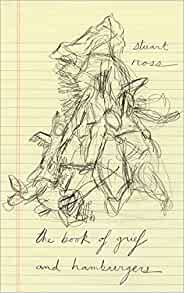
THE BOOK OF GRIEF AND HAMBURGERS


TITLE - THE BOOK OF GRIEF AND HAMBURGERS 

WRITTEN BY - STUART ROSS 

PUBLISHED BY - ECW PRESS 

PUBLICATION DATE - 5TH APRIL, 2022 

 Hamburgers have featured heavily in Stuart Ross’ poems over the years. Usually introduced, according to the poet himself, when emotions were running high and some levity was needed, they work overtime in this remarkable book. 

In the mostly autobiographical, aptly-titled “The Book of Grief and Hamburgers”, Stuart Ross discusses vegetarianism, Jewishness, Kafka, hamburgers and even people called Hamburger, but mostly he writes about grief; grief following the death of his brother, (something I can relate to), the death of friends and about famous writers who wrote about grief….and hamburgers. A book-length essay, written in verses much like a long poem, the text flows easily, its length unnoticed or irrelevant, like a conversation with an old friend. Famous quotes from films and notable last words pepper the book, albeit after having been “hamburger-fied” (my word for having key words removed and replaced with “hamburger”. Drawings, family photos and poems by other poets also make poignant appearances. 

If you hadn’t already guessed, this is a tough book. As it progresses, the reader gets the impression that Ross is using hamburgers as a “safe space” (to use a modern term) to avoid facing his grief. And there is a lot of it, as friend after friend contacts him to tell him they are either ill or already facing death. Being surrounded by death prompts him to consider suicide. Correctly identifying grief as more of a process of coming to terms, he invites the reader along for the ride. He asks difficult questions - what were his brothers’ last thoughts? Did they know they were dying? Questions that we have undoubtedly asked ourselves at such times. 

Ross makes the profound and affecting observation that he is alive in a world where he will never talk with his parents or brothers again, and wishes he could not be alive himself. At one point he realises that he is procrastinating about facing his own grief in the book, but the reader is happy to stick with him, especially when it’s this well-written.

This stunning work is a eulogy for those who have already passed, and a pained scream for connection with those who are still living. Cathartic, profound, remorseful and brilliant, “The Book of Grief and Hamburgers” is about grief and learning how to grieve, about seeing someone for what might be the last time, and as someone who has been very recently bereaved, at times the book is almost too much to bear. Anyone holding out for a happy ending will be disappointed, but as a way of working through grief this book is a therapy session that you’ll be glad you signed up for.

Tuesday, October 5, 2021

MURMURATION


TITLE - MURMURATION 

WRITTEN BY - BLAKE AUDEN

PUBLISHED BY - CENTRAL AVENUE PUBLISHING

PUBLICATION DATE - OUT NOW 


 Oh my…this is raw. 


To quote Blake Auden - “Some days poetry is the stitches other days it’s the wound”. 


“Murmuration” is a collection of untitled poems in three parts, (or three long poems) some lasting for only a few sentences, others longer. Each one is a tortured scream of emotion over a lost love. Approaching poetry as a form of cathartic healing, Auden uses spare, fragile words to puncture the page as he shares his constant pain. But as the quote above shows, sometimes poetry does more harm than good. Getting these emotions out on to the page seems to be an almost violent act. 

Interspersed throughout the book are drawings, like small boxes, containing short poems and doodles in black ink, deeply scratched circles of emotion and images of Auden’s ever-present ghosts. Mostly we get white pages with black text, but there are also black pages; these always come as a surprise making the sparse words on the pages more visceral. Auden has distilled emotion and meaning down to its barest, most potent form. 

I could easily quote the entire book, but here are just a couple of extracts - 


“…the word goodbye is no longer carrion  in my throat”


“your name is the softest word I have for suffocation. the gentlest way i know to drown.”


There are far too many breathtaking lines to quote; I should stop now as this pretty much killed me - 


“the truth is you fell in love with the words and not the broken hands that wrote them”


2021 is fast becoming a stellar year for poetry. I feel privileged to have discovered Auden’s work and I was truly shaken by this collection of stunning poetry. I urge everyone to read Blake Auden’s poetry, but prepare to have your heart ripped out. 


BUY IT FROM BOOKSHOP.ORG!


Thursday, September 2, 2021

ALL THE NAMES GIVEN


Anyone worrying that Raymond Antrobus had mellowed after his debut book of poetry, “The Perseverance”, would do well to consider this extract from “Language Signs”, the third poem in his second collection “”All The Names Given”, 

“All the men who raised me are dead, those bastards. I’m one self-pitying prick of a son.”

Yes, these are angry poems, but they are often tinged with tenderness and hope. 

The book begins with poems exploring people through the ages who have shared the surname Antrobus, from slavers to painters, and their legacy, Achingly personal at all times, there are snapshots of Antrobus’ turbulent upbringing exploring themes of race, cultural identity and his own deafness, though the latter not to the same extent as in the previous book. It is always there in the subtext of his poems, though, as he relates awkward moments of miscommunication. The poems take us through Raymond’s life from difficult adolescence right up to his marriage. Many of the poems appear almost prose-like in structure, so much so that it has the feel of an autobiography at times and can be a tad overwhelming, but maybe that’s deliberate. The poetry of Raymond Antrobus is brutally direct and requires, even demands rereading. 

Having been blown away by “The Perseverance”, this new work doesn’t disappoint but it impresses in a different way. Antrobus experiments with poetic forms in order to tell his stories, something which is never less than thrilling. While I feel that this collection is maybe not quite as immediate as “The Perseverance”, it is still a raging, beautiful volume from one of the most important poets of his generation. Reading the poetry of Raymond Antrobus is a visceral experience that will leave you shaken.


BUY IT FROM BOOKSHOP.ORG!

Sunday, August 22, 2021

A SOCIALLY ACCEPTABLE BREAKDOWN


 Oh wow…I feel eviscerated.


Poet and Carly Rae Jepsen fan Patrick Roche has crafted a stunning collection of visceral poetry that explores themes of love & loss, eating disorders, depression, mental health and suicidal thoughts (so trigger warnings for all) with a verbal dexterity that is often breath-taking. Roche relates his childhood as the boy who “only got a clock stuck on midnight” with an alcoholic father, in a life touched by tragedy. 

In the clever “Retcon”, he compares the practice of “retconning” (when comics and TV show writers change details in previous storylines to fit in with new ones) to being able to change traumatic events in his own life-“and I think what a luxury it would be to erase or reset 

at the stroke of a pen”. That resonates so much with me, not least because of the cultural reference. 

Prepare to go through the emotional wringer in poems such as the heartfelt (and heart-breaking) “Self-Portrait as Piranha Plant” or “Suburbs in July”, a poignant reminder of the things we deliberately don’t or are unable to say even to those closest to us. “Gravity” explores the twisted logic of an eating disorder whilst several poems wrestle with depression. 

I could quote forever - “My father drank himself into a funeral” from “Icarus”; “I start doing homework at Starbucks/I have more meaningful conversations with the barista than with my family” from “21”, a stunning entry told in a reverse countdown; “It’s so easy to tell someone you “forgot” to eat breakfast/If you word it the right way” from “Hocus Pocus”, which begins as a tribute to the movie of the same name but becomes something darker and will resonate with readers with eating disorders. Oh wow, here’s another line from it -“What is more witchcraft than the way this/body keeps moving forward/even when I put nothing into it”. 

Oh god, here’s another awesome couple of lines - “So my phone grows heavier and heavier, heavy with/an albatross of words, heavy with apologies I should be/offering…” from “Ode to My Unread Messages”. 

Things get progressively tougher in the third part. “Instructions on Having the Perfect Panic Attack” is exactly that and should be approached with caution, whilst “Every 40 Seconds” refers to the official statistics of how many people commit suicide each year, and it is about suicide, and oh boy, it’s a tough one, especially if you’ve been touched by suicide, but it ends on a hopeful note - “Hundreds of thousands of people are dying in silence/because of silence/but this is saying/we can keep each other breathing”. This is the best poem about suicide I have ever read. The final poem “Open Letter to the Author”, in which Roche addresses himself, ends the collection positively - “There’s a difference between you and yesterday./One still exists.”  

Gut-wrenching, heart-breaking and brutally honest, “A Socially Acceptable Breakdown” shows Patrick Roche can do things with the alphabet that will turn you inside out.


BUY IT FROM BOOKSHOP.ORG!

Sunday, July 18, 2021

THE HEEDING

"The Heeding" is an excellent collection of thirty-five poems by Rob Cowen, written during and inspired by the pandemic of 2020 and hauntingly Illustrated by Nick Hayes with drawings which sometimes lean towards "folk horror". although the poems themselves don't fall into this category.
After an incredibly well-written and moving introduction, the visceral opening poem, “Duel”, tells of a battle between a hawk and a rat - 

“Then it bends to rip out a strip
of glistening purple gut
and swallows the lot”

This poem is a statement of intent for what we can expect from the poetry going forward. Nature is raw and brutal, and its power and indifference is exposed in these verses, and some form of bird or creature or element of the natural world is always present in each poem. However, isolation also leads to a renewed appreciation of nature. Capturing the seemingly hopeless days of lockdown perfectly- the boredom of isolation, the separation from loved ones, the constant barrage of demoralizing news. The reference to discarded face masks littering the streets resonated strongly.
There are some very affecting lines - “Hell of a thing to be afraid of air.", and on the whole these are emotional verses, but there is humour too, in particular in “Lovers”, which tells of two young people caught in the act late at night - 

"Now, reasons for being outside are concrete-set:
A form of exercise? Well, you might argue that.
He was certainly burning calories down there, 
Pants round his ankles, backside bare.” 

Elsewhere, we get tales of first love and lost love, but the realities of the pandemic are ever-present shadows - 

“Passing her on the street, a couple
automatically swerve six feet.”

The shocking “Black Ant”, in which the author tries, but fails, to help a trapped ant, rams home the inevitability, and in some ways, the futility, of life, but the final poem, "Duel Part II", brings us full circle and gives us hope that we should keep trying - 

"Death? Inevitable, yes, but not yet.
Or not today, at least." 

"Lockdown poetry" will no doubt become a new genre in its own right, a kind of alternative written history of the pandemic, and "The Heeding" is one of the best examples I've read this year. There is death in these poems, but they also implore us to take heed of the natural world, each other and our relationship to it, and to hope for better times to come. 


Friday, July 16, 2021

BORN IN LOCKDOWN

The trials and hardships of Covid lockdown are all too recognisable in this satisfying volume of poetry by Tolu’ A. Akinyemi - the silence, the boredom, the stress and uncertainty. A narrative theme can be discerned throughout the verses; strained marriages, financial difficulties and loss - all recognisable fallout from the pandemic. Akinyemi also touches on the political consequences and “anti-vax” conspiracy theories. Not your average subjects for poetry, I grant you, but it all works. 
Poems vary in length and effectiveness but one very powerful poem is entitled “F*ck - F*cking 2020” which begins - 

“How do we scrub 2020 from our history books? 
How do we f*ck it off 
as a one-off?”

This is followed by a short declaration of intent called simply “F*ck 2020” which consists of just these two lines - 

“Rollback the years, f*ck 
twenty-twenty. Wipe out the 
               scars that blurred the year.”
  
Some of the best poems are short, brutal verbal assaults, while others are longer but no less bruising. “Passports” in particular resonated with me -

“My left arm carries so much weight
and immunity.”

Been there, done that. 
As you would expect, several poems contain (and often repeat) the word “pandemic”. To my ears, this sounds like the least poetically versatile word ever. It is neither lyrical nor elegant; but maybe that’s the point. Sometimes it works, as in the case of “Stories” - 

“Paint this pandemic what it was - 
a sordid misadventure”

This doesn’t harm the poems themselves, but it becomes rather repetitive. But then I suppose we’re all sick of that particular word. 
Nobody has ever published a book of poetry entirely filled with superb odes, but while this volume has its share of unsuccessful poems, there are enough to make it a worthwhile read. I think Akinyemi is a better poet when he’s angry. He cuts very close to the bone at times and the world of lockdown he evokes will be painfully familiar to everyone. These poems are a worthy and satisfying record of one of the hardest years in human history.