Total Page views

Showing posts with label history. Show all posts

Wednesday, September 7, 2022

BLOG TOUR - THE FALL OF ROMAN BRITAIN AND WHY WE SPEAK ENGLISH


TITLE - THE FALL OF ROMAN BRITAIN AND WHY WE SPEAK ENGLISH 

WRITTEN BY - JOHN LAMBSHEAD 

GENRE - ROMAN BRITAIN/EUROPE IN THE THIRD & FOURTH CENTURIES 

PUBLISHED BY - PEN & SWORD BOOKS 

PUBLICATION DATE - AVAILABLE NOW 


In “The Fall of Roman Britain and Why We Speak English”, prolific author, tabletop wargaming buff and designer of the “Fourth Protocol” computer game (I fondly remember playing it!), John Lambshead, explores the end of the Roman Empire in Britain and the circumstances that led to its inhabitants speaking what would become the language we know today as English. This is a thorough and enlightening history of the “bit in between” the end of the Romans and the beginning of Britain.

In many ways an historical detective story, John Lambshead undertakes a forensic study using geological, archaeological, climatological and biological evidence to uncover the causes of Roman collapse and the origins of the British people. At the end of each themed chapter, he draws convincing conclusions from the evidence. The chapter dedicated to “Londinium” supplies a wealth of knowledge about the Roman origins and purpose of the city that would become London. Also, Lambshead writes powerfully well about the domino effect of climate change and leadership battles leading to the devastating crisis of the third century.


The story is tied up in a convincing narrative at the end of the book, along with a bibliography and a timeline of events, using the dates generally accepted to be correct. John Lambshead, like all the best historians, has a command of his subject so, whilst complex in parts, his book is rigorously researched, always engrossing and easy to read.

BUY FROM PEN & SWORD

BUY FROM AMAZON

Monday, February 21, 2022

BLOG TOUR - ALEXANDER THE GREAT VERSUS JULIUS CAESAR | WHO WAS THE GREATEST COMMANDER IN THE ANCIENT WORLD?


TITLE - ALEXANDER THE GREAT VERSUS JULIUS CAESAR | WHO WAS THE GREATEST COMMANDER IN THE ANCIENT WORLD?
 
WRITTEN BY - SIMON ELLIOTT

PUBLISHED BY - PEN & SWORD BOOKS 

PUBLICATION DATE - AVAILABLE NOW 
---------------------------------------------------------------------

They are two of the most accomplished military leaders in history and both knowingly destined for greatness from an early age, but if you’ve ever wondered exactly which of them was the best - Alexander the Great or Julius Caesar - then this book will help you decide. 

In his quest to determine just who was the greatest military leader of all time, Simon Elliott’s book draws on surviving (but often exaggerated or incomplete) primary sources and the work of contemporary historians. An introduction sets out the structure of the book - each leader’s life and achievements considered in turn - and includes notes on terminology and timeline. Despite an admitted preference for Alexander, Simon Elliott covers each leader even-handedly. Starting with Alexander, he lucidly documents the almost continual conflict that led to Philip II (father of Alexander)’s reign. 

This is history at its most violent, a time of invasions, battles and intrigues when you could lose your throne to a member of your own family at the point of a blade. There is a wealth of detail on contemporary weapons and tactics and Elliott depicts the many battles with brutal drama. Five decisive battles and/or sieges are closely examined by the author as evidence of his military prowess. Similarly, with Julius Caesar, the author provides context to the Roman leader’s life with a chapter on the violent creation of the Roman Republic, (beginning with the legend of Romulus and Remus), a concise biography and a study of his major battles and campaigns. Elliott’s depiction of Caesar’s infamous murder is brutally compelling, and contains the heartbreaking fact that Caesar’s last act was to pull his toga over his head when he saw that his friend Brutus was one of his assassins.


In a climactic round of historical “Top Trumps”, Elliott ends the book with a summing up of his findings by directly comparing the leaders on factors such as brutality, conquests, strategic skills etc, and their enduring legacies. In short order, he reaches a perfectly logical conclusion - which I won’t spoil here. The book is further enhanced with annotated colour plate photographs of artefacts, maps, locations and models of soldiers in the armour of their time. There is also a bibliography, full index, and a striking, full colour dust-jacket.

If nothing else, then Simon Elliott’s book is a fresh reappraisal of the lives and legacies of two towering historical figures, with many myths exploded along the way. Elliott freely admits that we know, or at least think we know, more about Julius Caesar than Alexander, and indeed the former has always held more of a fascination for people. Simon Elliott’s excellent book certainly goes a long way towards redressing the balance by placing Alexander the Great in a wider historical context. Displaying an unprecedented depth of research into the structure of both leaders’ armies, their battles and campaigns, this book is indispensable for military and ancient history enthusiasts.

BUY IT FROM PEN & SWORD

BUY IT FROM BOOKSHOP

BUY IT FROM AMAZON

---------------------------------------------------------

About Dr Simon Elliott

Dr Simon Elliott is an award winning and best selling historian, archaeologist, author, broadcaster, Honorary Research Fellow at the University of Kent, Trustee of the Council for British Archaeology, Ambassador for Museum of London Archaeology, Guide Lecturer for Andante Travels and President of the Society of Ancients. He has published many well-received books on themes related to the ancient world, most recently the Amazon no.1 best-selling "Roman Britain’s Missing Legion", and frequently appears on broadcast media as a presenter and expert on ancient world and military themes.


Tuesday, February 8, 2022

STALIN'S LIBRARY


TITLE - STALIN'S LIBRARY 


WRITTEN BY - GEOFFREY ROBERTS 


PUBLISHED BY - YALE UNIVERSITY PRESS, LONDON 


PUBLICATION DATE - 8TH FEBRUARY 2022


A voracious reader, Josef Stalin had his own library of some 25,000 books, for which he employed the services of a librarian. He developed his own classification system and ex-libris stamp, and was fond of annotating and marking the books he read. He was a great respecter of books, if not of the people who wrote them. Whilst Stalin despised his political opponents, he paid close attention to their writings. 

A surprising portrait of the infamous Russian leader emerges from the scholarly pages of “Stalin’s Library” by Geoffrey Roberts - that of an intellectual and deep thinking bookworm and autodidact who revered books, even berating his own children when they treated them poorly. Roberts discovers a tantalising (though not a complete) insight into the real Stalin by analysing the way he read his books and the marks he made in them. It is also an attempt to provide a verifiable biography of Stalin, debunking many “conspiracy theories” and incorrect yet widely believed facts about him. 

Stalin was, conversely, shy of allowing books to be written about himself, vetoing many biographies and pamphlets, and those that were published were vigorously marked up if he disagreed with them. However, Stalin was more enthusiastic about the creation of his collected writings, a popular publication running to thirteen volumes until they were halted by Khrushchev. There is a revealing chapter on these books, their legacy and the unpublished final volumes, and very interesting details of the specific genres of books that Stalin favourited and the historical attempts to study his library. The longest chapter in the book is devoted to an rich and illuminating study of Stalin’s “potemki”, the marks, annotations and sometimes angry crossings-out that he added to many of the books he read. 

Geoffrey Roberts has written a very readable and intelligent book; ostensibly pro-Stalin only in regard to establishing a factual biographical life of the man, and thoroughly researched. While there is much about Stalin’s library itself and its legacy and how his reading influenced him as a political leader, the book is also a history of Stalin’s rise to power and beyond. While this does create something of an identity crisis at times, this book is excellent throughout and is highly recommend to anyone searching for a slightly different take on Stalin’s life and times.


Saturday, January 29, 2022

THE CHURCH AND THE AGE OF REFORMATIONS (1350 - 1650)


TITLE - THE CHURCH AND THE AGE OF REFORMATIONS (1350 -  1650)


WRITTEN BY - JOSEPH T. STUART & BARBARA A. STUART 


PUBLISHED BY - AVE MARIA PRESS

 
PUBLICATION DATE - 8TH APRIL 2022


The latest volume in the “Reclaiming Catholic History” series documents the era from 1350 to 1650, incorporating the years leading up to the Protestant Reformation and its aftermath. The series aims to present an unbiased and objective timeline of “Christian history” - ostensibly a “just the facts” from “God’s point of view” - whilst making the story accessible and entertaining. I am not a Christian, but I applaud any attempt at an overview of history from a more honest and human perspective.

The title of the book is a statement of intent - this was the era of not just THE  Reformation, but of many.  The authors, Joseph T. Stuart and Barbara A. Stuart, offer a contemporary and modern reassessment of the Reformation that is never boring, writing accessibly and vividly to bring the era and it’s people to life. Towering historical figures such as Thomas More, Johanes Gutenberg (whose printing press would have a profound effect on the accessibility of the Reformation) and of course Martin Luther, a personal hero of mine. Rightly remembered as the instigator of change, this book shows that the genesis of that change had begun much earlier. 

The book includes a chronological timeline of the era from 1350 to 1650, a map, bibliography and a full index. Sidebars entitled “Up Close And Personal” give concise biographies of the key players of the time, and the “You Be The Judge” panels invite the reader to make up their own mind about events and institutions such as the Spanish Inquisition; the latter having many of its enduring myths debunked. 

This book was a refreshing read. It looks at history from a new perspective whilst remaining eminently scholarly, and deserves to be widely read.

Tuesday, January 18, 2022

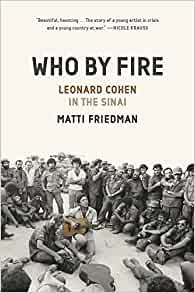
WHO BY FIRE - LEONARD COHEN IN THE SINAI


TITLE - WHO BY FIRE - LEONARD COHEN IN THE SINAI 

WRITTEN BY - MATTI FRIEDMAN 

PUBLISHED BY - SPIEGEL & GRAU 

PUBLICATION DATE - 29TH MARCH 2022 

As a recent convert to the music and wisdom of Leonard Cohen, I have been actively searching out books about his life and career, especially if they offer an interesting and original angle. 

Journalist Matti Friedman’s excellent and timely work “Who By Fire - Leonard Cohen in the Sinai” is one such book. It tells the true and astonishing story of an extraordinary chapter in the career of singer and songwriter Leonard Cohen that not only changed his life but also left an indelible impact on the state of Israel itself. To quote Friedman - “Sometimes an artist and an event interact to generate a spark far bigger than both”. 

In 1973, Cohen travelled to Israel during the conflict known as the Yom Kippur War to give impromptu concerts to Israeli troops at the front lines in the Sinai desert. Friedman makes use of an unpublished document which Cohen himself wrote about his experiences during this time, as well as interviews with people who were there and actually attended the “concerts”. 

Friedman paints a vivid account of the effect of Cohen’s songs on the young soldiers. Cohen himself was also reinvigorated by his journey, going on to write some of his best-known songs, including “Hallelujah”, after having contemplated retirement some months before. But Cohen’s visit also affected the nation’s music and “spiritual life,” leading the country to abandon “the militant secularism of the founders for an openness to the old wisdom.” This may sound incredible but Cohen was an incredible artist, and Friedman’s erudite prose brings the story to life with stunning credibility. 

Friedman’s scholarly work is a glorious testament to a great artist and to the enduring power of song to change the world.

Monday, January 17, 2022

THE STASI POETRY CIRCLE

 
TITLE - THE STASI POETRY CIRCLE 


WRITTEN BY - PHILIP OLTERMANN 

PUBLISHED BY - FABER AND FABER LTD

PUBLICATION DATE - 24TH FEBRUARY 2022 

Philip Oltermann’s book “The Stasi Poetry Circle” is, on the surface, a black comedy, which would make for a hugely enjoyable movie. The book’s chapters are split into “lessons” and comically entitled “Bathos” and “Dissonance” etc, giving this work the feel of a school text book. The contents are a connected series of stories which tell the tale of how the Stasi tried to win the war through poetry. The history has been deeply and skilfully researched, and it is an accessible read. 

Whilst not the craziest thing ever to happen during the Cold War, this is nevertheless a quirky and poignant account of one bizarre chapter of it. At once both deadly serious and totally ridiculous, “The Stasi Poetry Circle” is highly recommended for students of the Cold War and readers who enjoy unusual histories.

Saturday, November 20, 2021

QUEEN VICTORIA - HER LIFE AND LEGACY


TITLE - QUEEN VICTORIA - HER LIFE AND LEGACY 


AUTHOR - PAUL KENDALL 


PUBLISHED BY - PEN & SWORD 


PUBLICATION DATE - FEBRUARY 28TH, 2022 


Arguably Britain’s greatest ever monarch, Queen Victoria’s era is regarded by many as a golden age in British history, and it is hard to argue with that after reading Paul Kendall’s excellent pictorial history, “Queen Victoria - Her Life and Legacy”. 

This book is a visual document of the locations associated with Victoria’s reign, from her place of birth in Kensington Palace, to her death bed;  objects used by her and notable events. There is captivating photography throughout and while it may appear to be a superficial book on the surface, upon reading it becomes clear that this work is a thorough and scholarly history of Queen Victoria’s entire life. Each chapter has a short write-up about the history of the subject, and each passage has real historical depth. 

We get a vivid picture of Victoria’s life, especially her tentative, nervous and grief-laden early years when she assumed the throne aged just 18. Surviving several assassination attempts, she became a powerful monarch who ruled over one of the biggest empires the world had yet seen, creating many institutions and cultural changes which still resonate today. 

A very accessible book that can be understood and enjoyed by all ages, Paul Kendall’s “Queen Victoria - Her Life and Legacy” is richly informative and a joy to read. It is a fitting record of one of the greatest monarchs in British history.


Monday, November 15, 2021

BLOG TOUR - BAR KOKHBA | THE JEW WHO DEFIED HADRIAN AND CHALLENGED THE MIGHT OF ROME

TITLE- BAR KOKHBA | THE JEW WHO DEFIED HADRIAN AND CHALLENGED THE MIGHT OF ROME 


AUTHOR -  LINDSAY POWELL 

PUBLISHED BY - PEN & SWORD BOOKS 

PUBLICATION DATE - OUT NOW 


There have been very few people throughout history of whom it can be said that their deeds continue to influence the world long after their time. It is argued by many that Shi’mon Ben Kosiba, aka Bar Kokhba (“Son of the Star”), was one such man, although the details of his remarkable life and impact are little known outside the Jewish faith. Yet the man and his achievements are still lauded and debated today.

Author Lindsay Powell takes a balanced, critical approach to the evidence. He visited ancient sites and uncovered long lost letters; there is a strong sense of discovery as Powell travels through the erstwhile Holy Land in search of his quarry. Bar Kokhba the man is revealed in these scholarly, thoroughly researched pages. Powell effortlessly depicts the turbulent era, with clear explanations of Hadrian’s swift rise to power, becoming an active and popular leader, and the background and history of Judea and the Jewish people; to this day, still a volatile part of the world.

Hadrian rebuilt the ruined Jerusalem, effectively in his own image, at the same time overturning many of the cherished precepts of the faith, causing resentment. Into this powder-keg, Shi’mon Ben Kosiba, a man not without faults, appeared almost out of nowhere, as there is little surviving biographical knowledge about him. He was swiftly accepted as the saviour of the Jewish faith and hailed as the “King Messiah”, fermenting armed resistance against Roman occupation. Destined to be beaten, Ben Kosiba nevertheless planted the seed that eventually led to a clarion call for the creation of a Jewish homeland. Powell also examines the aftermath of the war and its lasting effects on Judaism, including the diaspora and the beginnings of anti-Semitism throughout the following centuries.


Fully annotated illustrations, lush colour plates and maps bring the era to vivid life, while a chronology charts the history up to the modern era. There is also a section on relevant places to visit, a glossary of terms, a list of place names, both ancient & their modern equivalent, a bibliography and a comprehensive index. Lavishly produced with a striking cover, this is a heavyweight volume to treasure.

In his preface, author Lindsay Powell freely admits that his book cannot be the last word on the subject due to the limitations in the interpretation and quality of surviving research material, but I think he is being too modest. His book is scholarly and immensely readable; he has reinvigorated an important historical figure for the modern age. This is accessible history suitable for everyone; there’s even a Monty Python reference! The mark of a good history book is how well it tells you something you didn’t know, in which case this book is one of the best I’ve ever read. 

---------------------------------------------------------------------------------------------------------

ABOUT THE AUTHOR

Lindsay Powell is a historian and writer who has a passion for the history of the Roman Empire. He is news editor of Ancient History and Ancient Warfare magazines. His appearances include BBC Radio, Dan Snow's HistoryHit, and History Channel. He is the author of AUGUSTUS AT WAR, EAGER FOR GLORY, GERMANICUS and MARCUS AGRIPPA from Pen and Sword Books. A graduate of the University of Aston in Birmingham, he is a veteran of The Ermine Street Guard re-enactment society. He divides his time between Austin, Texas and Wokingham, England.

-----------------------------------------------------------------------------------------------------------------------------

BUY DIRECT FROM PEN & SWORD

BUY FROM BOOKSHOP

BUY FROM AMAZON


Friday, October 1, 2021

A SHORT HISTORY OF COFFEE

TITLE - A SHORT HISTORY OF COFFEE 

AUTHOR - GORDON KERR

PUBLISHED BY - OLDCASTLE BOOKS 

From the Boston Tea Party to the French Revolution, from business meetings to first dates, the humble bean has been the beverage of choice to accompany momentous and everyday events for hundreds of years. Gordon Kerr traces its history from its earliest appearance up to the present day.. 

The drink we know and love today dates back to prehistoric Ethiopia but was first mentioned in print in the 10th century, when an Arab physician discovered that it “fortifies the members…and gives an excellent smell to all the body.” And apparently the Prophet Muhammad could “unhorse forty men and possess forty women” after drinking an early form of coffee. Not exactly the kind of behaviour one is used to seeing in Costa, but anyone who has enjoyed a cup of black coffee first thing in the morning knows where he was coming from. Facts like this abound in this excellent book by Gordon Kerr. Comfy sofas in coffee shops? Introduced by two Syrian coffee-house owners in the 16th century.

Kerr also explores the darker side of coffee’s history, as its cultivation has often involved slave labour. The sections on this will shock you, especially when we are told that slave labour persists in some coffee-producing countries to this day. 

Coffee has also caused religious turmoil. In 16th century Cairo, when a preacher declared that coffee drinkers were not true followers of Muhammad it caused a riot, with worshippers attacking and burning a coffee house to the ground. 

Coffee has also played a significant role in the cultural history of Europe, and Kerr explores its growth in countries such as France, Germany and especially, as you’d expect, Italy. A chapter is also devoted to coffee’s impact on the Americas. 

The book is peppered with quotes from historical figures on encountering the miraculous drink. King Charles II, concerned about London coffee houses being used to spread gossip and “fake news”, sought to suppress them and coffee itself. He didn’t succeed. 

Gordon Kerr’s book is a well-written, meticulously researched, funny and thought-provoking history of our favourite beverage, with an astounding fact on every page, and is recommended reading for coffee lovers everywhere. 


Saturday, September 11, 2021

THE POPE'S GREATEST ADVERSARY | GIROLAMO SAVONAROLA

TITLE - THE POPE'S GREATEST ADVERSARY | GIROLAMO SAVONAROLA

AUTHOR - SAMANTHA MORRIS 

PUBLISHED BY - PEN & SWORD

 A lively and intelligent young man who was hungry for knowledge, Girolamo Savonarola’s unrequited love for the “girl next door” led him to depression and a hatred of corruption in the Church and the profligate ways of the rich. Resolving to take Holy Orders after hearing a friar delivering a passionate sermon, he set out on the path which would eventually lead him into conflict with Italy’s most powerful rulers and a brutal public execution, the grisly details of which we are not spared in these pages. 

“The Pope’s Greatest Adversary - Girolamo Savonarola” by Samantha Morris is aptly titled. A powerful orator who over-reached himself, he caught the public imagination at an incendiary and God-fearing time in history, and was said to preach with a “voice of thunder” as he predicted cataclysmic events, one of which ostensibly came true and only added to his power. One could argue that Savonarola was a kind of Renaissance Rasputin, who also had a swift rise to influence and power, had both powerful friends and enemies and met a brutal end. Was Savonarola a positive force for change or simply a clever demagogue? The speed and simplicity with which he was able to oust the ruling Medici family and effectively rule Florence seems incredible to our modern eyes, but these were very different times.

And what are we to make of the “Bonfire of the Vanities” - public burnings in which thousands of works of art and literature were destroyed for being ungodly in the eyes of Savonarola and his cronies. A complicated and imperfect man, then, but an important one; certainly he was considered dangerous enough for Pope Alexander VI to attempt to silence and then excommunicate him. By the time of his downfall, Savonarola had obviously begun to believe he was untouchable. 

Fully illustrated with paintings of Savonarola and photographs of relevant locations in Florence, this is a concise and vivid slice of history. Featuring a colourful cast of characters including everyone’s favourite hedonists, the Borgias, (a singular family on which Samantha Morris has previously written very successfully), it is a solid biography of a remarkable man who still divides opinion today.


BUY IT FROM BOOKSHOP.ORG!

Thursday, September 2, 2021

INDEX, A HISTORY OF THE


Index, the humble. 

Most of us use a variation of it without thinking, but how many of us know when the index was invented and how it came to be there? Where would the Argos catalogue be without its index? Indexes still exist and are used everyday in our techno-world. When we use Google, we are not searching the internet; we are searching Google’s index of the internet. “Index, A History of the” is a love letter to the omniscient, alphabetical list that lurks at the back of all self-respecting books (including this one); your last hope when you can't remember which page something was mentioned on. I love a good index myself and am perfectly at home using one. Many’s the time I’ve had a “What no index?” moment after buying a new book which you’d expect to have an index only to discover there isn’t one. 

Author Dennis Duncan charts the index’s labyrinthine history in a lighthearted and supremely readable way. There’s been a welcome rash of unconventional and idiosyncratic books like this lately which is to be celebrated. This is a short book but it is wide-ranging and original. Every page has interesting facts that you probably didn't know you didn’t know. It is so filled with quirky nuggets that you will want to share them with total strangers (restrictions permitting). It is a pleasant journey into the development of the very mechanics of reading, and is also beautifully illustrated.