Total Page views

Showing posts with label autobiography. Show all posts

Sunday, October 24, 2021

THIS IS MY OFFICE AND NOTES ON MY MOTHER'S DECLINE

TITLE - THIS IS MY OFFICE AND NOTES ON MY MOTHER'S DECLINE 

WRITTEN BY - ANDY BRAGEN 

PUBLISHED BY - NORTHERN UNIVERSITY PRESS

PUBLICATION DATE - 15TH JANUARY, 2022


 Andy Bragen’s book contains two short, autobiographical and quietly powerful plays entitled “This Is My Office” and “Notes On My Mother’s Decline”. 

“This Is My Office” is an unconventional, metafictional work where the fact that the play features an actor playing a character in a play is freely acknowledged. We follow Andy Bragen himself who delivers a monologue while taking the “audience” on a tour of his office space, and ultimately of his life. He often breaks the fourth-wall (or whatever it’s called in a stage-play) to address the audience, regretting his failure to get to the point of the play. Andy talks about unfinished screenplays, his childhood, his parents; sleeping in his office and binging on doughnuts. Along the way there is a funny reference to the film “Naked Gun”, personal confessions and a final reconciliation with his father which culminates in a very moving ending. 

“Notes on My Mother’s Decline” is a two-handler, equally unconventional in written form in that the text isn’t structured like a play. There is only one stage direction -  “Mother” speaks the lines in bold and “Son” speaks the lines that aren’t. The son speaks short sentences about what his mother is doing in her apartment - smoking, sleeping, drinking coffee - while the mother’s lines narrate her steady decline in health in the form of one-sided conversations, both on the phone and in person. This is only changed at the end of the play, when the mother and son are finally “together”. Like its predecessor, this play is incredibly personal, often embarrassingly so, with a shocking twist towards the end. The end itself is, once again, intensely moving. 

I found reading both plays an incredibly moving experience. They must be very powerful when performed. I haven’t encountered Andy Bragen’s work before but I am immensely glad that I took a chance on this wonderful book.

BUY IT ON BOOKSHOP.ORG!

Wednesday, October 6, 2021

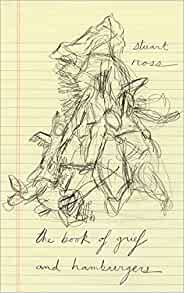
THE BOOK OF GRIEF AND HAMBURGERS


TITLE - THE BOOK OF GRIEF AND HAMBURGERS 

WRITTEN BY - STUART ROSS 

PUBLISHED BY - ECW PRESS 

PUBLICATION DATE - 5TH APRIL, 2022 

 Hamburgers have featured heavily in Stuart Ross’ poems over the years. Usually introduced, according to the poet himself, when emotions were running high and some levity was needed, they work overtime in this remarkable book. 

In the mostly autobiographical, aptly-titled “The Book of Grief and Hamburgers”, Stuart Ross discusses vegetarianism, Jewishness, Kafka, hamburgers and even people called Hamburger, but mostly he writes about grief; grief following the death of his brother, (something I can relate to), the death of friends and about famous writers who wrote about grief….and hamburgers. A book-length essay, written in verses much like a long poem, the text flows easily, its length unnoticed or irrelevant, like a conversation with an old friend. Famous quotes from films and notable last words pepper the book, albeit after having been “hamburger-fied” (my word for having key words removed and replaced with “hamburger”. Drawings, family photos and poems by other poets also make poignant appearances. 

If you hadn’t already guessed, this is a tough book. As it progresses, the reader gets the impression that Ross is using hamburgers as a “safe space” (to use a modern term) to avoid facing his grief. And there is a lot of it, as friend after friend contacts him to tell him they are either ill or already facing death. Being surrounded by death prompts him to consider suicide. Correctly identifying grief as more of a process of coming to terms, he invites the reader along for the ride. He asks difficult questions - what were his brothers’ last thoughts? Did they know they were dying? Questions that we have undoubtedly asked ourselves at such times. 

Ross makes the profound and affecting observation that he is alive in a world where he will never talk with his parents or brothers again, and wishes he could not be alive himself. At one point he realises that he is procrastinating about facing his own grief in the book, but the reader is happy to stick with him, especially when it’s this well-written.

This stunning work is a eulogy for those who have already passed, and a pained scream for connection with those who are still living. Cathartic, profound, remorseful and brilliant, “The Book of Grief and Hamburgers” is about grief and learning how to grieve, about seeing someone for what might be the last time, and as someone who has been very recently bereaved, at times the book is almost too much to bear. Anyone holding out for a happy ending will be disappointed, but as a way of working through grief this book is a therapy session that you’ll be glad you signed up for.

Thursday, September 2, 2021

ALL THE NAMES GIVEN


Anyone worrying that Raymond Antrobus had mellowed after his debut book of poetry, “The Perseverance”, would do well to consider this extract from “Language Signs”, the third poem in his second collection “”All The Names Given”, 

“All the men who raised me are dead, those bastards. I’m one self-pitying prick of a son.”

Yes, these are angry poems, but they are often tinged with tenderness and hope. 

The book begins with poems exploring people through the ages who have shared the surname Antrobus, from slavers to painters, and their legacy, Achingly personal at all times, there are snapshots of Antrobus’ turbulent upbringing exploring themes of race, cultural identity and his own deafness, though the latter not to the same extent as in the previous book. It is always there in the subtext of his poems, though, as he relates awkward moments of miscommunication. The poems take us through Raymond’s life from difficult adolescence right up to his marriage. Many of the poems appear almost prose-like in structure, so much so that it has the feel of an autobiography at times and can be a tad overwhelming, but maybe that’s deliberate. The poetry of Raymond Antrobus is brutally direct and requires, even demands rereading. 

Having been blown away by “The Perseverance”, this new work doesn’t disappoint but it impresses in a different way. Antrobus experiments with poetic forms in order to tell his stories, something which is never less than thrilling. While I feel that this collection is maybe not quite as immediate as “The Perseverance”, it is still a raging, beautiful volume from one of the most important poets of his generation. Reading the poetry of Raymond Antrobus is a visceral experience that will leave you shaken.


BUY IT FROM BOOKSHOP.ORG!

Sunday, August 15, 2021

IN PURSUIT OF CALM


Even though I haven’t lived a life remotely like Daniel Fuselier’s, I don’t think I’ve ever felt so much sympathy for someone before.
Surviving drug abuse and alcoholism in two separate “drinking lives” and an accident which causes third-degree burns over more than half of his body, Daniel recounts how he was able to turn his life around by “direct physical and mental contact with a spiritual entity”. 
Growing up in New Orleans, childhood trauma led him to resentment and hatred of his father and his new wife - the “Stepmonster” - but he discovered a bond with his father through his first taste of alcohol, ultimately leading to wild partying in high school and the start of his alcoholism.
Lyrical passages relate his blissful school days filled with fun and friendship. Drinking became Daniel’s way of easing social anxiety but this leads to destructive behaviour and accidents. He always seems on the edge of achieving something but self-doubt always prevents him. Once he achieves his goals, we rejoice with him. 
“In Pursuit of Calm” is a harrowing yet rewarding read, and it doesn’t matter whether or not you believe in spiritual entities, the reader can still take a lot of comfort from this inspirational book.

Wednesday, July 14, 2021

MAYBE I DON'T BELONG HERE


Actor David Harewood pulls no punches in his autobiography in which he shares the formative events of his life that led to psychotic episodes after becoming an actor, and which ultimately led to him being sectioned twice. Harewood writes in such a friendly, conversational style that is so easy to read that it makes his harrowing depiction of the psychotic episodes that much more effecting. He is completely open about his breakdown and hopes that the book will encourage others, especially Black people, to overcome the stigma of mental health and seek help. 

He vividly describes his early childhood and an early life-changing experience of racist abuse in which his psyche is “split” into two separate personas, English and Black. This is juxtaposed with scenes of a warm and loving family life, his love of the TV comedians of the time and the rarity of seeing a black actor on television at the time. This is something I remember myself from growing up, and he paints a very familiar picture of late ‘60s, early ‘70s Britain. Soon David finds himself assimilating into the “white space”. His happy school life, in which he evolved to be the class clown, changes when his father is sectioned following a breakdown. Harewood sees similarities in the drastic changes both he and his father had to undergo through living in England and admits “the white space had taken its toll on both of us”. His parents later divorce also causes the young David a great deal of pain and confusion. 

We share his initial euphoria at becoming an actor which soon ends in a haze of alcohol and drug use due to psychological pressure from another actor. The title of the book is a phrase that Harewood keeps saying to himself as he struggles with his identity and feels rejected even by the “Black space” - “maybe I don’t belong here”.

It is around this time in his life when, David admits, his mind begins to unravel. He vividly describes his manic episodes where he would take walks late at night, wavering between periods of lucidity and psychosis, and often wake up the next morning in completely unfamiliar surroundings. The most extreme psychotic event results in him being arrested after believing the voice of Martin Luther King was in his head, directing him, and ends with David being sectioned twice and admitted to a psychiatric hospital. The chapter on this, entitled “The Ward”, is heartbreaking, and on the (probably unwise) advice of his brother he decides to “act normal” to get out of the hospital. Eventually, through sheer resilience, he is able to restart his acting career and to finally find inner peace while playing parts all over the world, which would ultimately lead to him starring in the show “Homeland”. He admits that his illness has given him a resilience to survive in the acting business and that it possibly shook “some of the bullshit” out of him. 

The book also touches on Harewood’s shock at discovering the disproportionate amount of black people in the mental health system in the UK. A 2019/2020 survey discovered that “Black and minority people suffer elevated rates of psychosis and schizophrenia compared with white people”. This leads to Harewood making his acclaimed BBC documentary, “Psychosis and Me”, in which he finally learns the real truth about how ill he had been during his breakdown and the production is a profoundly moving experience for him. 

This is a raw and honest book about being Black, (Harewood capitalises the word throughout) and about what it means to be Black with mental health problems. The book is refreshingly free of “luvviness”; Harewood necessarily mentions the famous actors he has worked with, but he never loses his starstruck amazement at meeting people like Al Pacino. He bemoans the greater opportunities for Black actors in the USA compared to the UK; pointing this out once got him into a bit of trouble. David Harewood’s book is heartbreaking yet hopeful, and I read it in one sitting. 


BUY IT FROM BOOKSHOP.ORG!


Sunday, July 11, 2021

THE RIGHT SORT OF GIRL


"I’m a girl and northern and brown, didn’t you know? A triple threat!”

Three things which I, and probably most people, view with complete indifference, but which Anita seems to be daring us to take issue with in her autobiography. This doesn’t bode well - please don’t judge me, Anita, just get on with telling your story.

I’ve always quite liked (or at least, not entirely hated) Anita Rani as an amiable and chirpy Northern presenter on this and that, but it’s unsurprising that Anita’s book treads very familiar paths. Not fitting in as a child, check; coming to terms with her race, check; things she wished she could tell her younger self, check. All the tried and tested elements of a 21st Century biography are present then, but, ultimately, she just isn’t that interesting. The sections on her television career pass the time but offer no major revelations and are very much of the “Asian woman struggling to succeed in a white male-centric world.” All very modern and boring. The glowing quotes from “celebrity” readers call this book inspirational; but one man’s “inspirational” is another man’s “banal".

This a very safe, Guardian Books-friendly tome with absolutely nothing out of the ordinary within its pages. If you like Anita Rani then you’ll probably like her book as it contains nothing that will put you off her - it’s just that nice Anita Rani “off the telly” talking about herself.


BUY IT FROM BOOKSHOP.ORG!