Total Page views

Sunday, February 13, 2022

STALKING THE ATOMIC CITY


TITLE - STALKING THE ATOMIC CITY

WRITTEN BY - MARKIYAN KAMYSH 

PUBLISHED BY - PUSHKIN PRESS 

PUBLICATION DATE - 7TH JULY 2022 

Beginning with a potted and putrid history of the Chornobyl accident and displaying unconcealed disgust at the creation of nuclear power which promised an Utopia but delivered Hell on Earth, Markiyan Kamysh’s “Stalking The Atomic City” screams relentlessly from the pages in vivid, honest and profane language. 

This is a story about Stalkers, a subculture of adventurers unafraid of the radiation that still permeates the Chornobyl Exclusion Zone and its surroundings, described here as being the size of Luxembourg, including the infamous town of Prypyat. Kamysh, who is one of many such people, recounts his experiences as an “illegal tourist”, spending days or often weeks hiking through the Zone, sometimes with friends, camping out, getting drunk and exploring the deserted buildings. Run-ins with police, looters and wildlife, sleeping next to the remains of dead wolves and battles with the merciless Russian elements are tempered with the breathtaking sights of the Zone such as the Chornobyl-2 antennas, described vividly as “behemoths” and “titans”. In the abandoned houses, Markiyan finds peace, and considers himself to be the real deal amongst the rich hipsters who visit the Zone.

Markiyan also offers a field guide of sorts to the virgin visitor to the Zone,- what to wear, what to take - but advises us to do it not because he tells us to, but because we are degenerate; that normal people have no business even being there. He tells us about his father who was one of the original clean-up crew after the Chornobyl accident, of shepherding naive first-timers on trips into the Zone through waist-deep snow, and shares a beginner’s guide to looting. The Zone is almost like an addiction for Kamysh; he curses the Zone, hates it and swears he’ll never go back, but he always does, if only to feel the overwhelming relief of leaving it. He feels proprietorial towards the Zone, much like the titular stalker in the film by Andrei Tarkovsky; it is like a lover, the ultimate non-sexual relationship. He mourns the dismantled Chornobyl landmarks, victims of the most recent clean-up. Asked about the dangers to his health, he has no fears, taking life as it comes, his way. 

Haunting, monochrome photographs from inside the Zone, pepper the book, stark reminders captured for all time. The English translation by Hanna Lelia and Reilly Costigan-Humes of the 2015 Russian original is excellent, creating an unfussy style that is very easy to read. The writing is lean and immediate with hardly a word wasted. 

Markiyan’s story is told with a sense of freedom and irreverence throughout, and I felt a little envious of his having found joy and contentment, even in such an ostensibly awful place. We can envy him this, if not exactly the location where he finds it. “Stalking The Atomic City” is a short and affecting book that is full of life in a place of death and I cannot recommend it highly enough.

Thursday, February 10, 2022

PLENITUDE


TITLE - PLENITUDE 

WRITTEN BY - DANIEL SARAH KARASIK 

PUBLISHED BY - BOOK*HUG PRESS 

PUBLICATION DATE - 7TH APRIL 2022 


Daniel Sarah Karasik’s “Plenitude” is a futuristic rallying cry for a generalisation of identity and society. These verses/passages are dense, kinetic and intelligent; rhythmic and often profane - adult trans-formational poetry for an undefined future. 

Daniel Sarah Karasik’s work is political, angry and confrontational, and it is quite breathtaking. The key poem is “trans-socialist” in which Karasik dreams of a society in which everything is, rather than one in which everything has to be something - a kind of communism (a term used with caution here) where we don’t have to worry about saying “communism” and “gender is reborn as pure play”. 

The poems are vital and sexy, in fact downright filthy in parts, often darkly funny but always screamingly honest. Karasik works hard at making you (the reader or anyone) like them and accept them, while at the same time liking and accepting themselves. Chapters are illustrated with striking graffiti art which suits the contents well. 

I know nothing about the trans condition but I like the future being created here, and I can enjoy this excellent poetry for what it is.


BUY IT FROM BOOKSHOP

RENAISSANCE

TITLE - RENAISSANCE 

WRITTEN BY - AMY CLENNELL 

PUBLISHED BY - CHERISH EDITIONS 

PUBLICATION DATE - 16TH MAY 2022

Poet Amy Clennell has overcome cerebral palsy and its associated disabilities to achieve major goals in her life and to take up writing, and “Renaissance” is her latest volume of poetry. There is certainly plenty of evidence of strength and determination in these wonderfully affecting poems.
There is a strong sense throughout the opening poem “Morwenna” of someone refusing to be beaten by their own imperfect body, but in “Ready To Fly” we get a harrowing glimpse of an unhappy childhood, and yet that inner strength shines through. 
Amy’s joy at a baby brother in “Sisterly Love” is heartwarming (even though she really wanted a sister) is followed by another show of that glorious f-you attitude in “Blessed” as Amy “duets” with singer Lemar at a concert in spite of an audience’s disapproval. Both angry and funny, when a poet rhymes “lackey” with “wacky baccy” you know you’ve discovered a rare talent! 
“My Alfie” is Amy’s heartfelt plea for connection with her autistic son, a stark and concise poem that hits hard. “The Elephant in the Classroom, “Special School”, Coundon” is a touching eulogy to a lost friend which displays Clennell’s poetical and linguistic skill at its very best. “Fringe of the Grove in Sunlight” and “Salvage” and “Sunflower Seeds of Hope” are a trio of cryptic verses with a lot of vivid and ethereal imagery. 
This continues in the series of poems inspired by paintings by artists such as Millais and Degas, and the short story “The Happy Prince” by Oscar Wilde. These are all very firmly rooted in the traditional poetic form yet there are glimpses of a cheeky frivolity in “The Jovial Jibes of the Swing” and “A Tragedy in Floriography” - Clennell isn’t being entirely serious here, despite the romantic and flowery language. “The Launderer’s Lament”, inspired by Edgar Degas’ painting “Women Ironing”, is the rhythmic, kinetic and funny inner monologue of a woman ironing rich men’s shirts. The “Sleeping Beauty”-inspired “A Gothic Romance” employs a clever acrostic device and is extremely vivid and windswept, while in “Courage and Kindness” Cinderella takes an uncertain step towards a new future, a poem that could be taken as an allegory of the courage Amy has shown in her life. 
Nature poem “Duel At Dawn” vividly conjures up the onset of winter. It’s the hallmark of a good poet if they can describe the unknowable power of the seasons. Violent death permeates “Postmortem” and “Lesson Learnt”, the latter depicting the drowning of a child by some kind of sea creature in lucid (and lurid) language, which shocks more due to its present-tense urgency. One of my favourites in the collection, “A Modern Troubadour”, all the more effective due to its conciseness, tells of a resolute minstrel unable to escape the inevitable end of his wandering existence. 
“Hope For Winter, A Story Of Dolphins”, inspired by the two “A Dolphin Tale” films, is an intense long-form poem about a dolphin enduring torment yet ultimately finding hope. “Evelyn Rose” is the titular pandemic baby, born uncertainly yet determined to survive; once again the overarching theme of survival against the odds is skilfully invoked.
The beautiful “In My Fairy Glen”, one of the true highlights of the book, shows how the simplest of things can conceal magic, while in the playful “Backyard Critters” relates a charming encounter with a baby turtle. “Fat Club” is a humorous snapshot of the temptations laid before a dieter, and the three “Limericks” that follow it, all about canine misadventures, are hilariously cheeky. 
Terrorism, London traffic and a headlong rush towards a TV appearance all combine in the heartwarming “An Unkindness of Ravens”, while in “Something To Do With Cake” Amy shares her joy at her brother’s wedding. “Sometimes The Grass Is Greener” is a tale of two people slowly becoming one, told through the metaphor of two horses, and is extremely touching and organic. 
This stunning collection is rounded off with the funny “What A Pantomime” about a panto Dame with a cheeky yet honest aspiration, and finally the colourful and vibrant “Renaissance”, a tribute to the Phoenix, and once again a metaphor for endurance against all odds. It is a magnificent end to an astonishing book. 
Simple yet apt artwork accompanies the poems while fragile haikus punctuate the text, acting as a palette cleanser. 
Amy Clennell has found a refuge in writing, and her readers will find a refuge in Amy Clennell’s writing. Gutsy, inspiring and uplifting, “Renaissance” is the best collection of poetry I have read for a long time; I am floored by Amy’s skill with words and emotions. I was put through the wringer but I loved every minute of it!

Tuesday, February 8, 2022

STALIN'S LIBRARY


TITLE - STALIN'S LIBRARY 


WRITTEN BY - GEOFFREY ROBERTS 


PUBLISHED BY - YALE UNIVERSITY PRESS, LONDON 


PUBLICATION DATE - 8TH FEBRUARY 2022


A voracious reader, Josef Stalin had his own library of some 25,000 books, for which he employed the services of a librarian. He developed his own classification system and ex-libris stamp, and was fond of annotating and marking the books he read. He was a great respecter of books, if not of the people who wrote them. Whilst Stalin despised his political opponents, he paid close attention to their writings. 

A surprising portrait of the infamous Russian leader emerges from the scholarly pages of “Stalin’s Library” by Geoffrey Roberts - that of an intellectual and deep thinking bookworm and autodidact who revered books, even berating his own children when they treated them poorly. Roberts discovers a tantalising (though not a complete) insight into the real Stalin by analysing the way he read his books and the marks he made in them. It is also an attempt to provide a verifiable biography of Stalin, debunking many “conspiracy theories” and incorrect yet widely believed facts about him. 

Stalin was, conversely, shy of allowing books to be written about himself, vetoing many biographies and pamphlets, and those that were published were vigorously marked up if he disagreed with them. However, Stalin was more enthusiastic about the creation of his collected writings, a popular publication running to thirteen volumes until they were halted by Khrushchev. There is a revealing chapter on these books, their legacy and the unpublished final volumes, and very interesting details of the specific genres of books that Stalin favourited and the historical attempts to study his library. The longest chapter in the book is devoted to an rich and illuminating study of Stalin’s “potemki”, the marks, annotations and sometimes angry crossings-out that he added to many of the books he read. 

Geoffrey Roberts has written a very readable and intelligent book; ostensibly pro-Stalin only in regard to establishing a factual biographical life of the man, and thoroughly researched. While there is much about Stalin’s library itself and its legacy and how his reading influenced him as a political leader, the book is also a history of Stalin’s rise to power and beyond. While this does create something of an identity crisis at times, this book is excellent throughout and is highly recommend to anyone searching for a slightly different take on Stalin’s life and times.


Wednesday, February 2, 2022

IN THE CITY OF PIGS

TITLE - IN THE CITY OF PIGS 


WRITTEN BY - ANDRE FORGET 


PUBLISHED BY - DUNDURN PRESS


PUBLICATION DATE - 12TH JULY 2022


Dundurn Press’ imprint Rare Machines has produced some impressive left-field novels in its short life, and André Forget’s “In the City of Pigs” joins that list with inscrutable aplomb. 

Forget has a succinct style that is a joy to read, and the novel has an air of clinical intellectualism. His descriptive writing is vivid and rich as he describes the sights and sounds of Toronto. A knowledge of Toronto would probably add another dimension to the story, as it is very much a love-letter to that city, it’s history and present, but non-residents can read the book and easily immerse themselves in a city so well described. 

As to the story itself, the book deals largely with an underground avant-garde music collective, complete with modern agitprop Twitter posts and anonymous videos in abandoned warehouses; an exciting premise which evokes the rave culture of the ‘90s with a postmodern sheen. But Fera Civitatem’s plans are more far-reaching than that, demanding a kind of reimagining of society itself. Forget’s depiction of one of their secret concerts is visceral and brutal, the atonal lovechild of a philharmonic orchestra and the Jim Rose Circus.

Undoubtedly the book is pretentious in parts, and in many ways cold and lacking emotion, but not in a way that I could take seriously. In fact, the pretentiousness seemed almost to be played for laughs. Readers with a love of classical musical will find much to enjoy (and, no doubt, hate) in the book. 

Characterisation is a little hit and miss, with only Alexander really standing out amongst a mostly indistinguishable supporting cast made up of unlikeable arty types. Chapters are generally short, maybe some a little too short, but it all seems just right, and the storytelling is brisk. 

Part contemporary fiction, part exposé of economic divisions, part musicological thriller; I would call the book intellectually absurdist, and despite its pretension, has a strong thread of irreverence and imagination running through it. While not precisely unputdownable, I did find myself picking up the book often for just one more chapter. It is definitely not for everyone, but I am comfortable with novels that are unconventional, and I enjoyed this one very much.


Tuesday, February 1, 2022

THE VELVET UNDERGROUND


TITLE - THE VELVET UNDERGROUND 

WRITTEN BY - CHRIS ROBERTS


PUBLISHED BY - PALAZZO EDITIONS LTD

PUBLICATION DATE - 7TH APRIL 2022 

Chris Roberts has created a small but perfectly formed biography of The Velvet Underground, one of the most inscrutable bands ever. Loud, rough, atonal; influential and iconoclastic. There aren’t enough words to do the band justice. 

Having personally met and interviewed Lou Reed three times, and even once accidentally sat on Nico’s coat, Roberts is eminently qualified to write this book, and it is an informative and sometimes shocking joy to read. 

Contemporary photographs and ephemera set the scene, whilst archive and personal interviews with the band, many conducted by the author, offer an insight into the minds of the band members - Lou Reed (grouchy), Cale (Welsh), Moe Tucker (sensible), Sterling Morrison (the quiet one). 

There is no shortage of books about The Velvet Underground, but few are as enjoyable as Chris Roberts’ one - it has the feel of a work by an insider. Knowledgeable, drugged-up and funny as heck, this book is indispensable.

BUY FROM BOOKSHOP!


Saturday, January 29, 2022

THE CHURCH AND THE AGE OF REFORMATIONS (1350 - 1650)


TITLE - THE CHURCH AND THE AGE OF REFORMATIONS (1350 -  1650)


WRITTEN BY - JOSEPH T. STUART & BARBARA A. STUART 


PUBLISHED BY - AVE MARIA PRESS

 
PUBLICATION DATE - 8TH APRIL 2022


The latest volume in the “Reclaiming Catholic History” series documents the era from 1350 to 1650, incorporating the years leading up to the Protestant Reformation and its aftermath. The series aims to present an unbiased and objective timeline of “Christian history” - ostensibly a “just the facts” from “God’s point of view” - whilst making the story accessible and entertaining. I am not a Christian, but I applaud any attempt at an overview of history from a more honest and human perspective.

The title of the book is a statement of intent - this was the era of not just THE  Reformation, but of many.  The authors, Joseph T. Stuart and Barbara A. Stuart, offer a contemporary and modern reassessment of the Reformation that is never boring, writing accessibly and vividly to bring the era and it’s people to life. Towering historical figures such as Thomas More, Johanes Gutenberg (whose printing press would have a profound effect on the accessibility of the Reformation) and of course Martin Luther, a personal hero of mine. Rightly remembered as the instigator of change, this book shows that the genesis of that change had begun much earlier. 

The book includes a chronological timeline of the era from 1350 to 1650, a map, bibliography and a full index. Sidebars entitled “Up Close And Personal” give concise biographies of the key players of the time, and the “You Be The Judge” panels invite the reader to make up their own mind about events and institutions such as the Spanish Inquisition; the latter having many of its enduring myths debunked. 

This book was a refreshing read. It looks at history from a new perspective whilst remaining eminently scholarly, and deserves to be widely read.

Tuesday, January 18, 2022

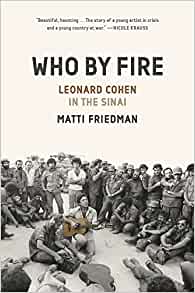
WHO BY FIRE - LEONARD COHEN IN THE SINAI


TITLE - WHO BY FIRE - LEONARD COHEN IN THE SINAI 

WRITTEN BY - MATTI FRIEDMAN 

PUBLISHED BY - SPIEGEL & GRAU 

PUBLICATION DATE - 29TH MARCH 2022 

As a recent convert to the music and wisdom of Leonard Cohen, I have been actively searching out books about his life and career, especially if they offer an interesting and original angle. 

Journalist Matti Friedman’s excellent and timely work “Who By Fire - Leonard Cohen in the Sinai” is one such book. It tells the true and astonishing story of an extraordinary chapter in the career of singer and songwriter Leonard Cohen that not only changed his life but also left an indelible impact on the state of Israel itself. To quote Friedman - “Sometimes an artist and an event interact to generate a spark far bigger than both”. 

In 1973, Cohen travelled to Israel during the conflict known as the Yom Kippur War to give impromptu concerts to Israeli troops at the front lines in the Sinai desert. Friedman makes use of an unpublished document which Cohen himself wrote about his experiences during this time, as well as interviews with people who were there and actually attended the “concerts”. 

Friedman paints a vivid account of the effect of Cohen’s songs on the young soldiers. Cohen himself was also reinvigorated by his journey, going on to write some of his best-known songs, including “Hallelujah”, after having contemplated retirement some months before. But Cohen’s visit also affected the nation’s music and “spiritual life,” leading the country to abandon “the militant secularism of the founders for an openness to the old wisdom.” This may sound incredible but Cohen was an incredible artist, and Friedman’s erudite prose brings the story to life with stunning credibility. 

Friedman’s scholarly work is a glorious testament to a great artist and to the enduring power of song to change the world.

Monday, January 17, 2022

THE EMPLOYEES


TITLE - THE EMPLOYEES

WRITTEN BY - OLGA RAVN | TRANSLATED BY MARTIN AITKEN

PUBLISHED BY - BOOK'HUG PRESS 

PUBLICATION DATE - 8TH MARCH 2022 

Shortlisted for the 2021 International Booker Prize (given to translated books), “The Employees” is a short science-fiction novel by Danish author Olga Ravn which tells the story of a spaceship manned by humans and humanoids (basically a kind of artificially “grown” human) and the consequences of their discovery of alien lifeforms on a planet. Both types of crewmembers begin to become attached to the aliens and start yearning for things and people they left behind on Earth whilst trying to maintain their strictly controlled productivity levels. This inevitably leads to conflict.

Now this is not a straightforward novel. It is told in the form of written “statements” taken from interviews with the crew during the unfolding of the story. This works quite well, and a palpable tension is built as the story is told through these snippets; some are a couple of pages long, others just one sentence. You will not know who is talking to begin with, but after a while a few different characters can be discerned, and you will come to understand who they are and the parts they play in the story.

I am not going to spoil the ending, but it would not take a genius to work out what happens. Even so, this book is a short but imaginative and often quietly profound examination of the dominance of work in our lives and ultimately what it means to be human.

BUY IT FROM BOOKSHOP


THE MEANING OF METALLICA | RIDE THE LYRICS


TITLE - THE MEANING OF METALLICA | RIDE THE LYRICS


WRITTEN BY - WILLIAM IRWIN 

PUBLISHED BY - ECW PRESS 

PUBLICATION DATE - 19TH APRIL 2022

I’m a casual but longtime fan of Metallica so the premise of this book intrigued me; it may be the first one purely devoted to a critical study of the lyrics of the band’s frontman James Hetfield. 
The title itself is bold and challenging, suggesting a definitive document, but that’s a symptom of the publishing world and not author arrogance. At any rate, the author himself offers the disclaimer that this is his own personal interpretation, not the final word, and that we are welcome to disagree with it and substitute our own.
  
William Irwin is clearly not just a fan of Metallica - he is a F A N of Metallica. This may make the book unpalatable to some readers, but I am fine with it as everyone is entitled to their own opinion, and I am making a personal choice to read Irwin’s. Subdivided into separate (big) themes such as religion (which comes first), addiction, war and freedom - all regular subjects of Metallica songs -  Irwin proffers his interpretation of Hetfield’s lyrics. 

If I am honest, a lot of his conclusions went over my head and many seemed to derive far too great a meaning from certain lyrics, but occasionally he made me look at my favourite Metallica songs in a totally new way, and his obvious affection for the songs is a positive rather than a negative factor. 

On the whole, “The Meaning of Metallica” is a success, shedding new light on familiar songs and encouraging debate. Anyone who disagrees with William Irwin’s conclusions is invited to write their own book.

THE STASI POETRY CIRCLE

 
TITLE - THE STASI POETRY CIRCLE 


WRITTEN BY - PHILIP OLTERMANN 

PUBLISHED BY - FABER AND FABER LTD

PUBLICATION DATE - 24TH FEBRUARY 2022 

Philip Oltermann’s book “The Stasi Poetry Circle” is, on the surface, a black comedy, which would make for a hugely enjoyable movie. The book’s chapters are split into “lessons” and comically entitled “Bathos” and “Dissonance” etc, giving this work the feel of a school text book. The contents are a connected series of stories which tell the tale of how the Stasi tried to win the war through poetry. The history has been deeply and skilfully researched, and it is an accessible read. 

Whilst not the craziest thing ever to happen during the Cold War, this is nevertheless a quirky and poignant account of one bizarre chapter of it. At once both deadly serious and totally ridiculous, “The Stasi Poetry Circle” is highly recommended for students of the Cold War and readers who enjoy unusual histories.